
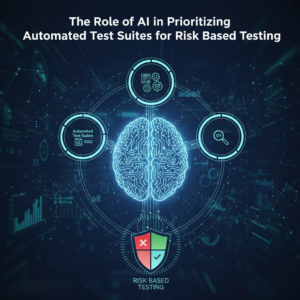
The Role of AI in Prioritizing Automated Test Suites for Risk Based Testing
AgileVerify
For a long time, test automation followed a simple rule. If you have tests, run all of them. As products grew and automation suites expanded, this approach started to break down. Pipelines became slower, feedback arrived too late, and teams spent more time waiting than learning. This is where AI driven test prioritization entered the conversation, not as a trend, but as a necessity.
At its core, risk based testing is about understanding that not all parts of a system carry the same weight. A failure in a payment flow, authentication, or data processing path has a very different impact than a minor UI inconsistency. The challenge has never been identifying risk. The challenge has been applying that understanding consistently when hundreds or thousands of automated tests are involved.
This is where AI in test automation starts to add real value. AI systems can analyse patterns that humans struggle to track manually. They look at historical test failures, recent code changes, execution frequency, and even production incidents. Instead of treating every test equally, AI helps surface which areas are most likely to break and which tests are most relevant right now.
One immediate benefit of AI based test prioritization is faster feedback. When high risk tests run first, teams get early signals about critical failures. This shortens decision making time and allows developers to react before a full pipeline completes. In fast moving teams, this difference can decide whether a release is delayed by minutes or hours.
However, this is where blind trust becomes dangerous. AI does not understand business context on its own. It does not know that a small looking change supports a major customer launch or a compliance requirement. AI can rank tests based on data, but it cannot fully understand user impact or business risk without human guidance.
This is why experienced QA involvement remains essential. AI suggests priorities. QA validates intent. A skilled QA engineer reviews AI recommendations and asks the uncomfortable questions. Why is this critical flow ranked lower. Why are we skipping this scenario today. These decisions protect teams from optimizing for speed while quietly increasing risk.
Another challenge teams face is coverage drift. When AI repeatedly deprioritizes tests that rarely fail, those tests can slowly become outdated or ignored. Over time, this creates blind spots. This is why risk based testing must be reviewed regularly, not just automated once and forgotten.
The most effective teams treat AI as a decision support system, not a decision maker. They combine AI insights, domain knowledge, and upcoming change awareness. Automation becomes smarter, not smaller. Pipelines become faster, but confidence remains intact.
This shift also changes the role of QA. QA is no longer the person who runs all the tests. QA becomes the person who understands where risk lives, when speed matters, and when caution is required. AI handles scale. Humans handle judgment.
The future of automation is not about running fewer tests. It is about running the right tests, at the right time, for the right reasons. AI makes this achievable. QA makes it responsible.
The real question teams should ask is not Can AI prioritize our tests but
Who takes responsibility when a prioritized test is skipped and production breaks